Looking for investment?
Our £16m Arts & Culture Impact Fund provides affordable repayable finance for socially driven arts, culture and heritage organisations registered and operating in the UK.

Our £16m Arts & Culture Impact Fund provides affordable repayable finance for socially driven arts, culture and heritage organisations registered and operating in the UK.

Image credits:
A photo from the Figurative conference, ‘The Power of Place: Cultural Philanthropy in 2026’. Photo by Chris Foster.
On 23 July, around 20 practitioners working to finance culture and creativity around the world met to compare two very different approaches to lending in the cultural and creative sectors.
On 23 July 2026 we held the second session in our global peer learning series on impact, investment and innovation in the cultural and creative sectors, convened by Figurative and chaired by Florencia Giulio of Pulso. As before, the group spanned Europe, the Americas and beyond: public funders, banks, intermediaries, advisors and researchers, several of whom have themselves lent to or borrowed for cultural organisations.
Where the first session looked at impact measurement and outcomes-based grants, this one turned to repayable finance itself: loans and blended models designed for organisations that mainstream lenders tend to overlook. Florencia set the scene by naming the shared problem. Many cultural organisations have viable business models but do not fit standard credit criteria, and the sector’s heavy reliance on shrinking short-term grants makes generating new sources of capital more pressing than ever. Two cases, from the Netherlands and from Mexico, showed how that gap can be filled in practice, and how much the right answer depends on context.
The first case came from Cultuur+Ondernemen (Culture and Enterprise), a Dutch non-profit organisation that has been lending to artists, creatives and cultural organisations for over a decade. Its cultural loan programme is now a revolving fund of around €110 million, lending anywhere from €5,000 to €500,000 at interest rates of 2 to 5%, with terms usually up to five years. Decisions rest on the business case and the applicant’s financial track record, not on any judgement of artistic merit. Lending sits alongside a substantial capacity-building programme, on the premise that cultural organisations need tailored support to operate entrepreneurially, not the generic for-profit training that rarely fits their circumstances.
The presentation was candid about the model’s realities. The programme is not, at present, cost-efficient: the interest revenue does not cover the cost of running it, in large part because so many loans are small and advice-heavy, and public subsidy remains necessary to fill the gap. Different disciplines carry very different risks, with fashion and film flagged as particularly high-risk based on some of its prior investments. The default rate sits at around 5%, meaning the great majority of loans return to the fund to be lent again. And a point worth dwelling on for anyone worried about market distortion: because the programme deliberately serves borrowers the banks have already turned away, an independent analysis verified the finding that it does not distort the commercial market, instead filling a genuine gap, enabling projects that would not otherwise exist.
A couple of tensions ran through this case. The first is the long horizon: building a fund of this size took many years, and the portfolio only grew significantly in the last five, as the Dutch Ministry of Education, Culture and Science came to see the demand and the results and increased its support. The second is the future funding mix. The programme is currently fully publicly funded, and while there is appetite to bring in private capital, particularly for more asset-backed or revenue-generating projects such as cultural property and immersive experiences, the sector’s thin profit margins and the programme’s limited investment track record above €500,000 have been a barrier.
The second case came from the Secretariats of Culture and Economy of the State of Nuevo León in Mexico, with Banca Afirme, a private commercial bank. Cultura Capital is a recent programme, developed in 2024, and is described as the first public-private microcredit programme for the cultural sector in the country. It grew out of a statewide study, Tierra Incógnita, that mapped the local creative economy and identified access to finance as a critical barrier. The programme offers creative entrepreneurs interest-free microloans, ranging from MXN 70,000 to MXN 500,000 (mexican peso), alongside workshops and advice on finance, project management and business development.
An interesting exposition of the mechanics drew the most questions. Cultura Capital is a blended finance model in which the government subsidises 65% of the interest and assumes the credit risk through a reserve fund, while Banca Afirme provides the capital and the remaining 35% of the interest. This model ensures that the loans are effectively interest-free for borrowers, while providing a liquid guarantee equivalent to 30% of the loan to cover first losses. The scheme creates a multiplier effect on the programme’s investment: as borrowers build a repayment history, the reserve fund is progressively released and recycled into new lending.
By this mechanism, the presenters reported that roughly MXN 10 million of public money has been leveraged into around MXN 26.8 million of credit disbursed: for every Mexican peso the government commits to interest, approximately three pesos of financing reach creative entrepreneurs. To date the programme has granted 76 loans worth some MXN 15.5 million.
The bank’s motivation, in response to a question from the group, is financial inclusion: reaching people who have never held formal credit and helping them build the history that will later let them borrow from mainstream finance, with the prospect of a preferential rate if they graduate to the bank’s own products. For the government, the appeal is impact leverage. The same public money that might otherwise fund a fixed number of grants or scholarships is multiplied several times over as repayable finance.
Here too, the presenters were open about the challenge of ensuring the continuity of public policies in the cultural sector. The group asked how a “virtuous mechanism” of this kind can be protected across different electoral cycles. The response was instructive: the initiative emerged from the Nuevo León 2040 strategic plan, a framework of long-term strategic public policy projects.
The two case studies are complementary. Both provide repayable finance to independent artists, creatives and cultural organisations; both serve borrowers seeking to invest, start projects or bridge cashflow gaps; and both recognise that smaller loans require intensive, and costly, hands-on support, which is why each pairs finance with capacity-building. Both also depend, to differing degrees, on public or concessional support to make the economics of lending work at all.
The differences are just as illuminating. Cultuur+Ondernemen is a mature, fully public revolving fund charging below-market interest rates; Cultura Capital is a new, blended public-private model offering interest-free microcredit. One has a decade of data, including a 5% default rate; the other is too young to report one. And the two are, in a sense, converging from opposite directions: the Dutch programme is exploring how to draw in private capital, while the Mexican programme is built on private bank capital from the outset and is working to develop its long-term public policy strategy.
The recurring theme, and the most useful thread for the wider group, was the role of public capital: what minimum level of public or concessional support is needed to make lending to culture viable, and in what form. Interest subsidy, guarantees, first-loss capital, funded technical assistance and covering the operating costs of advice-heavy small loans all featured. A related question, raised by several participants, was how practitioners persuade governments to back repayable finance in the first place. The answers pointed in the same direction: demonstrate genuine demand, prove that you are filling a gap the market will not serve, and report honestly on the results.
As with the first session, we closed by asking what this community should become and how it should be run. Participants have been sent a short survey covering future themes, format, and how the initiative ought to be governed as it evolves. The candid answer remains that this is a work in progress, and we see it as a genuine collective learning space drawing on a wide range of perspectives.
If you are working on, or seriously exploring, finance for the cultural and creative sectors, we would be glad to have you at a future session. And if you have thoughts on any of this, including what a global community of practice in this field should look like, please email seva.phillips@figurative.org.uk.

Following earlier posts on financial resilience and how our investment has been used, we wanted to look squarely at what our money has pulled in alongside it.
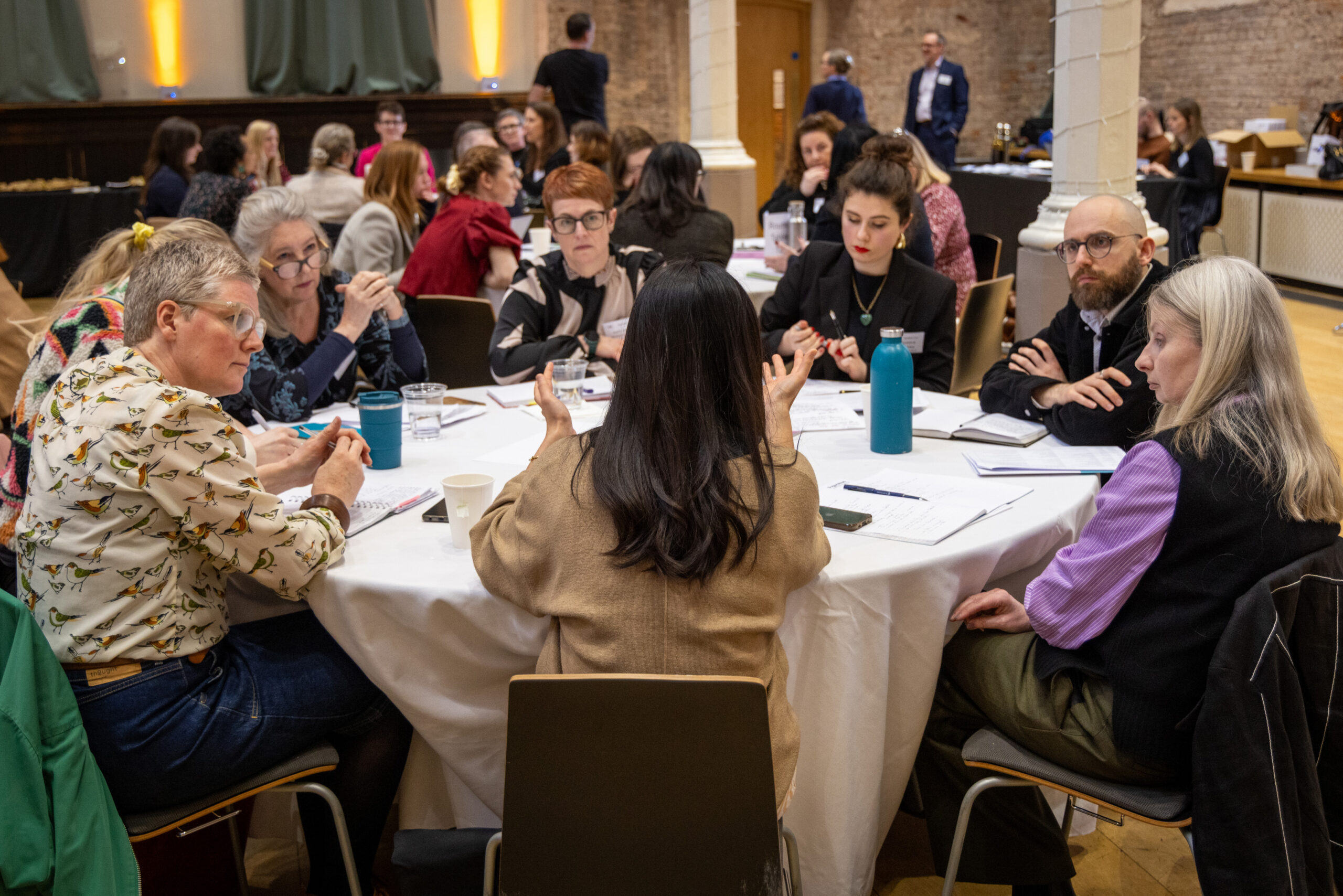
On 2 July, around 20 practitioners working to fund culture and creativity around the world met to discuss the strengths and challenges of impact measurement and outcomes-based funding models.

In the second of our new Meet the Team series, we meet Theoni Androulidaki, Figurative's Investment Analyst, to learn about her background and work.
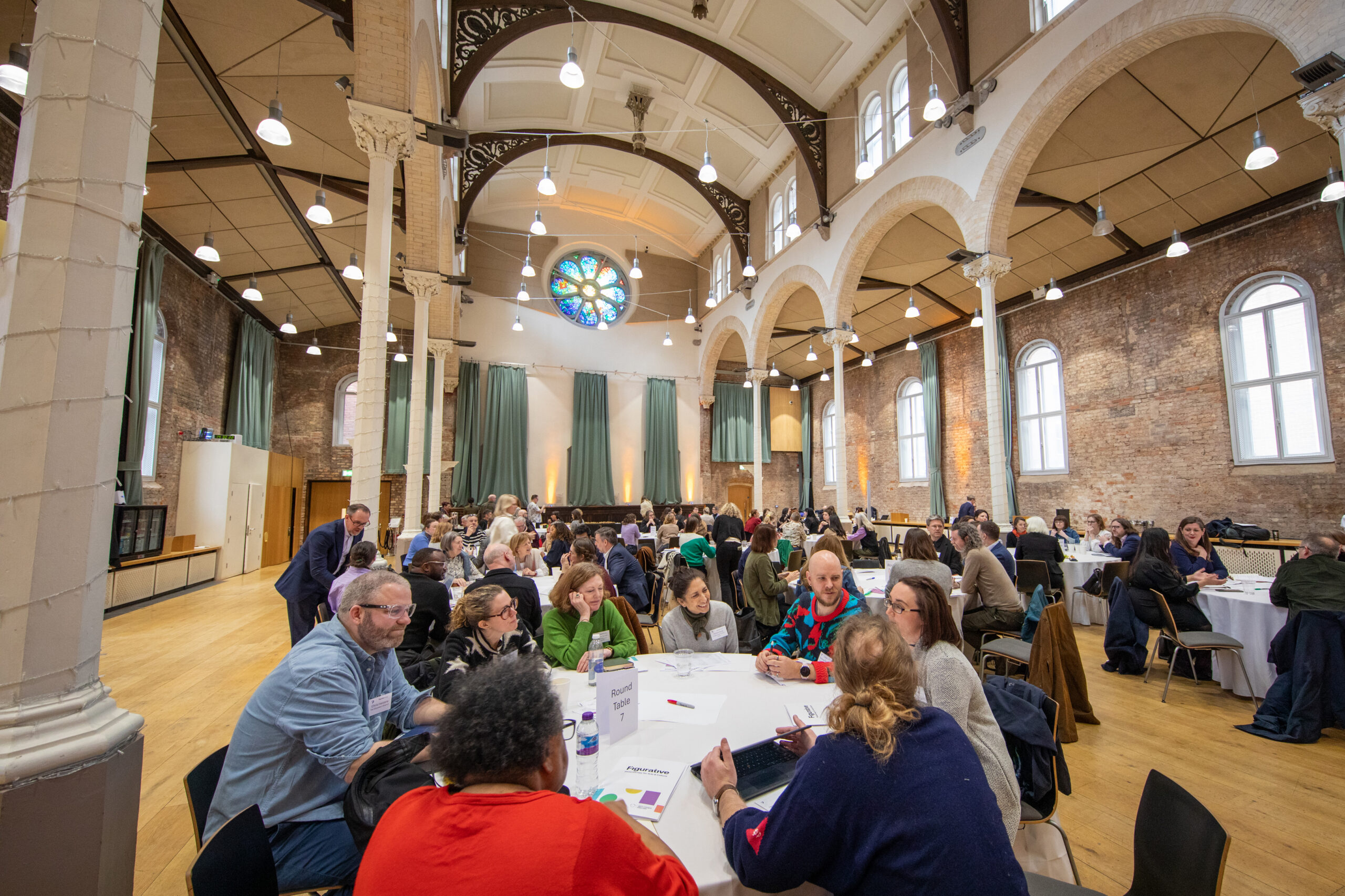
Seva Phillips introduces a new series encouraging candid conversations between practitioners financing culture in different parts of the world.