Looking for investment?
Our £16m Arts & Culture Impact Fund provides affordable repayable finance for socially driven arts, culture and heritage organisations registered and operating in the UK.
Our £16m Arts & Culture Impact Fund provides affordable repayable finance for socially driven arts, culture and heritage organisations registered and operating in the UK.
Analysis of seven sustainable retrofit projects found a simple average return on investment of 10.7%, with projects typically paying back their costs through savings in under 10 years.
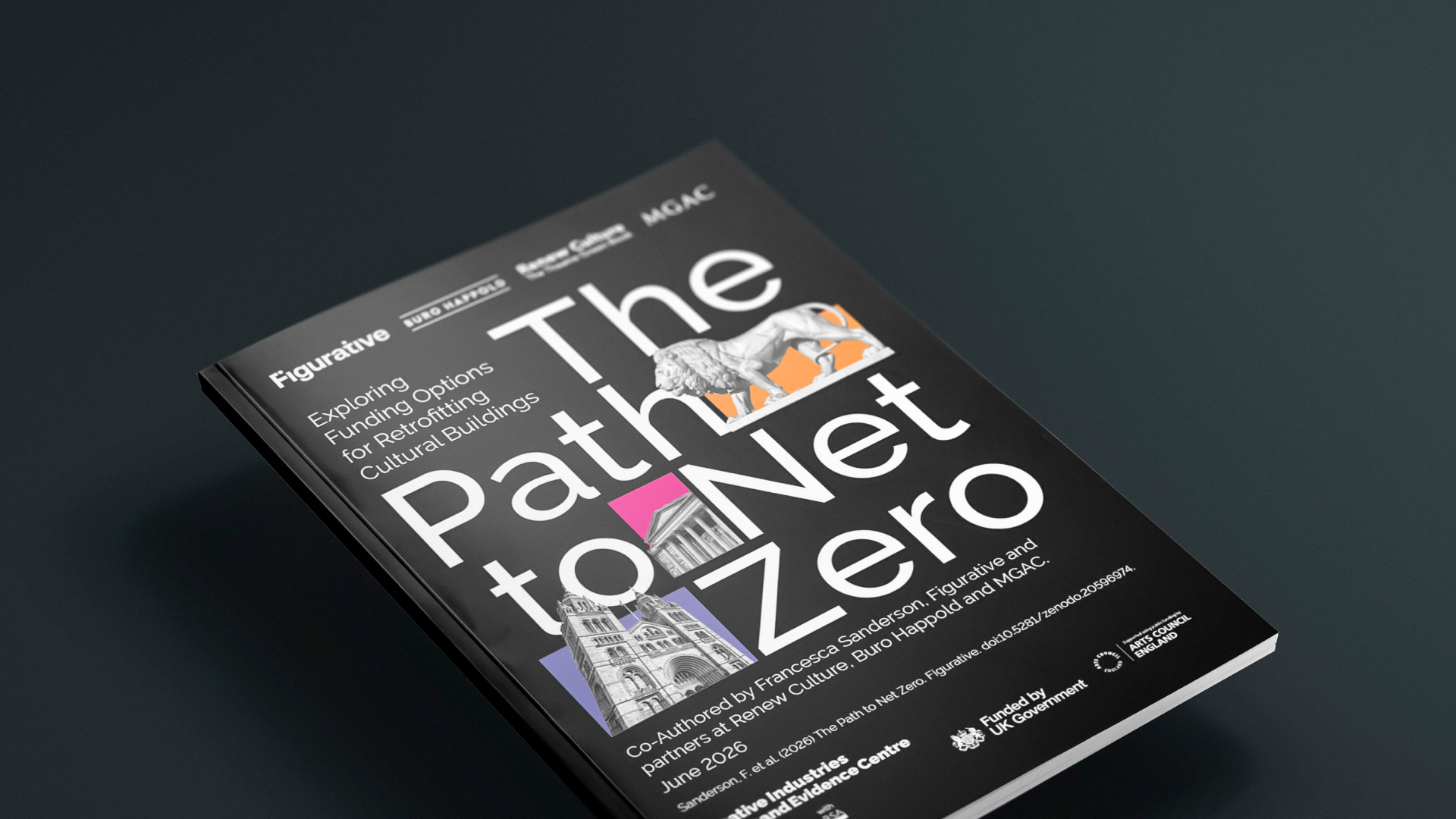
Retrofitting (adapting existing buildings to be more energy efficient) the UK’s theatres, galleries, cinemas and cultural buildings generates significant cost and energy savings, creating a clear opportunity for funding models that combine grants with impact investment, according to a major new case study analysis. ‘The Path to Net Zero: Exploring Funding Options for Retrofitting Cultural Buildings’ is co-authored by Fran Sanderson of Figurative and partners at Renew Culture, Buro Happold and MGAC, and commissioned by Arts Council England and the Creative Industries Policy and Evidence Centre (Creative PEC).
The report considers the capital costs and energy data of seven representative projects undertaken at cultural buildings in England and Wales – from the very large and high budget, such as the installation of 720 solar panels at the Wales Millennium Centre, to the small and low-cost, such as the addition of an air curtain at the entrance of the Oxford Playhouse. All were shown to have achieved measurable energy and carbon reductions, with a simple average return on investment (ROI) of around 10.7%.
‘The Path to Net Zero’ proposes that a collaborative blended capital financing vehicle – combining grant and loan funding – could attract new, impact-motivated investment capital to the sector, helping to bridge existing funding gaps for retrofits. Such a vehicle could also be designed to support implementation across the sector by creating procurement frameworks, strengthening knowledge and supply networks, and improving data consistency – streamlining the delivery of future projects and resulting in further economies of scale.
The report plugs a gap in existing analyses of cultural sector retrofits, which have typically focused on projected savings and theoretical data. Its practical assessment of how real-world projects have delivered demonstrable cost and carbon reductions is a first step to exploring how the sector might lead a coordinated, collaborative cultural shift to net zero in the UK. The findings also help to illustrate what a significant contribution decarbonisation efforts will make towards cultural organisations becoming self-sufficient, by growing the sector’s resilience and independence from shocks to the global energy markets.
The authors recommend the creation of a collaborative blended capital financing vehicle, designed and engineered to deliver implementation support alongside funding, and delivered by an appropriate partnership, which could:
Fran Sanderson, CEO of Figurative, said: “At Figurative we are always keen to explore how imagination can be applied to finance to stretch limited public resources further. Finding these seven pioneering organisations who have completed projects and have data to share, then exploring how they delivered their projects, not only reassured us there is a viable blended capital model for addressing this challenge, but also showed us how much capacity can be added to the cultural sector through a coordinated effort to provide innovative funding solutions with crucial support alongside, including the ability to share learning. This will derisk projects and improve funding economics as the sector progresses towards net zero, creating a virtuous circle to draw in additional capital.”
Nicola Saunders, Arts Council England’s Director of Environmental Responsibility and Innovation, said: “We are delighted that this report clearly shows both the economic and environmental benefits of decarbonising our creative and cultural buildings through capital investment in retrofitting projects. It inspires consideration and discussion of how innovative financial models – including repayable finance – could allow more creative and cultural organisations to carry out similar projects and support the sector’s climate resilience.”
Emily Hopkins, Policy Adviser at Creative PEC, said: “Cultural buildings are vital pieces of the UK’s creative infrastructure but face significant challenges in net zero adaptation. By examining the environmental and financial outcomes of real-world retrofit projects, this report offers new insights into how the sector can maintain and extend these important assets while reducing carbon emissions. We hope the findings will help policymakers and funders to further understand the opportunities and barriers associated with cultural retrofitting and contribute to more evidence-based policymaking and investment decisions in this area.”
Andrew Wylie, Partner at Buro Happold and Trustee of Theatre Green Book, said: “Cultural buildings are some of our most valued public assets, but many are ageing, energy-intensive and challenging to upgrade. What our research and case study analyses show is that retrofit can deliver measurable carbon and cost savings, while also improving the resilience and long-term viability of the organisations that occupy these buildings. I hope the approach taken in these varied projects can serve as inspiration for other cultural venues to plan for their own projects.”
Claire Buckley, Programme Lead at Julie’s Bicycle, said: “The case for a capital funding model to future-proof our cultural infrastructure has never been clearer. To truly realise the potential of our cultural buildings to decarbonise, build climate resilience and act as demonstrators of positive change, we need a holistic model, combining funding and investment with wider support and capacity-building for and of the sector.”
The research project was conceived by Figurative, an independent charity supporting impact, investment and innovation in the cultural sector, in partnership with Renew Culture, the organisation behind Theatre Green Book and Arts Green Book; Buro Happold, engineering and sustainability consultants; and MGAC, building consultants and quantity surveyors. It has been reviewed and endorsed by Julie’s Bicycle, who provide additional insights in the report, along with Gallery Climate Coalition, with further contributions and insights from the British Film Institute and the Linbury Trust.
The case study organisations are Space Studios, Milton Keynes Theatre, The Lowry, Russell-Cotes Art Gallery and Museum, Oxford Playhouse, Wales Millennium Centre and Chichester Festival Theatre.
The report was launched on Tuesday 16 June with an event at The Royal Society of Arts.
Arts Council England is the national development agency for creativity and culture. Between 2023 and 2026 we will have invested over £467 million of public money from Government, alongside an estimated £250 million each year from The National Lottery, to support individual practitioners, arts organisations, museums and libraries, and to help ensure that people in every part of the country have access to culture and creativity in the places where they live. Visit our website to learn more about our work: artscouncil.org.uk.
The Creative Industries Policy and Evidence Centre (Creative PEC) works to support the growth of the UK’s creative industries through the production of independent and authoritative evidence and policy advice. Creative PEC is led by Newcastle University with the Royal Society of Arts and funded by the Arts and Humanities Research Council. For more details visit: www.pec.ac.uk.
Figurative is an independent charity (Registered No.1214130) dedicated to impact, investment and innovation in the cultural and creative sector. As a global expert in impact investment for arts and culture, it specialises in raising and managing impact funds and attracting new philanthropy into the sector.
It conducts and supports research to make the case for impact investment and continuing innovation in the sector to funders, policymakers and the public. It also provides advisory services to support organisations and funders with impact and funding models, and helps international peers to achieve their goals. See more at: figurative.org.uk.
Renew Culture were co-founders of the Theatre Green Book, which has become the leading initiative for sustainable theatre worldwide.
Buro Happold is an international, integrated consultancy of engineers, designers and advisors. For nearly 50 years, we have built an unrivalled reputation by delivering creative, value-led solutions for the benefit of people, places and planet.
Described by clients as ‘passionate’, ‘innovative’ and ‘collaborative’, Buro Happold is synonymous with the delivery of exceptionally complex projects on every continent, working with the world’s leading architectural practices and organisations, such as the United Nations, UNESCO and C40 Cities.
Through our global community of driven, world-leading engineering, advisory and design professionals, Buro Happold is acting to address major challenges in an ever-evolving world. Find out more at www.burohappold.com.
MGAC is a global boutique consultancy dedicated to managing and representing its clients’ best interests. Its success is rooted in hiring exceptional people who are driven to do challenging work with the unique blend of experience, integrity, creativity, and commitment that separates it from its competitors. MGAC provides best-in-class services that include project management, program management, project controls, cost management, schedule management, technology solutions, FF&E procurement, relocation management, and health and safety. The firm has the ability to integrate these services to provide a completely customized and tailored solution to suit its clients’ project or program specific needs. For more information, please visit www.mgac.com.
Julie’s Bicycle (JB) unites culture, creativity and climate action to drive change. For nearly two decades, we’ve been at the forefront of the creative climate movement – one of the first to position culture as a powerful force for radical change. Our mission is to mobilise the creative sector, equipping thousands of artists, cultural organisations, and creative leaders with the tools, knowledge, and confidence needed to transform their practice into climate action. We focus on tackling the root causes of the climate, nature, and justice crises by shaping thinking, informing policy, and scaling practical solutions. Together, we can turn creativity into a powerful force for a just and regenerative future.
To mark our second anniversary, we've created a new infographic celebrating some of the highlights of the past year.
We’re hitting the road this July to meet socially driven arts, culture and heritage organisations in Cambridge and the South East.
Take part in our short survey as Figurative looks to develop a new type of finance for the cultural and creative sector. Win a £250 donation to a charity of your choice.

We’re launching Meet the Figurative Team - a regular short Q&A - offering a closer look at some of the brilliant people behind our work.